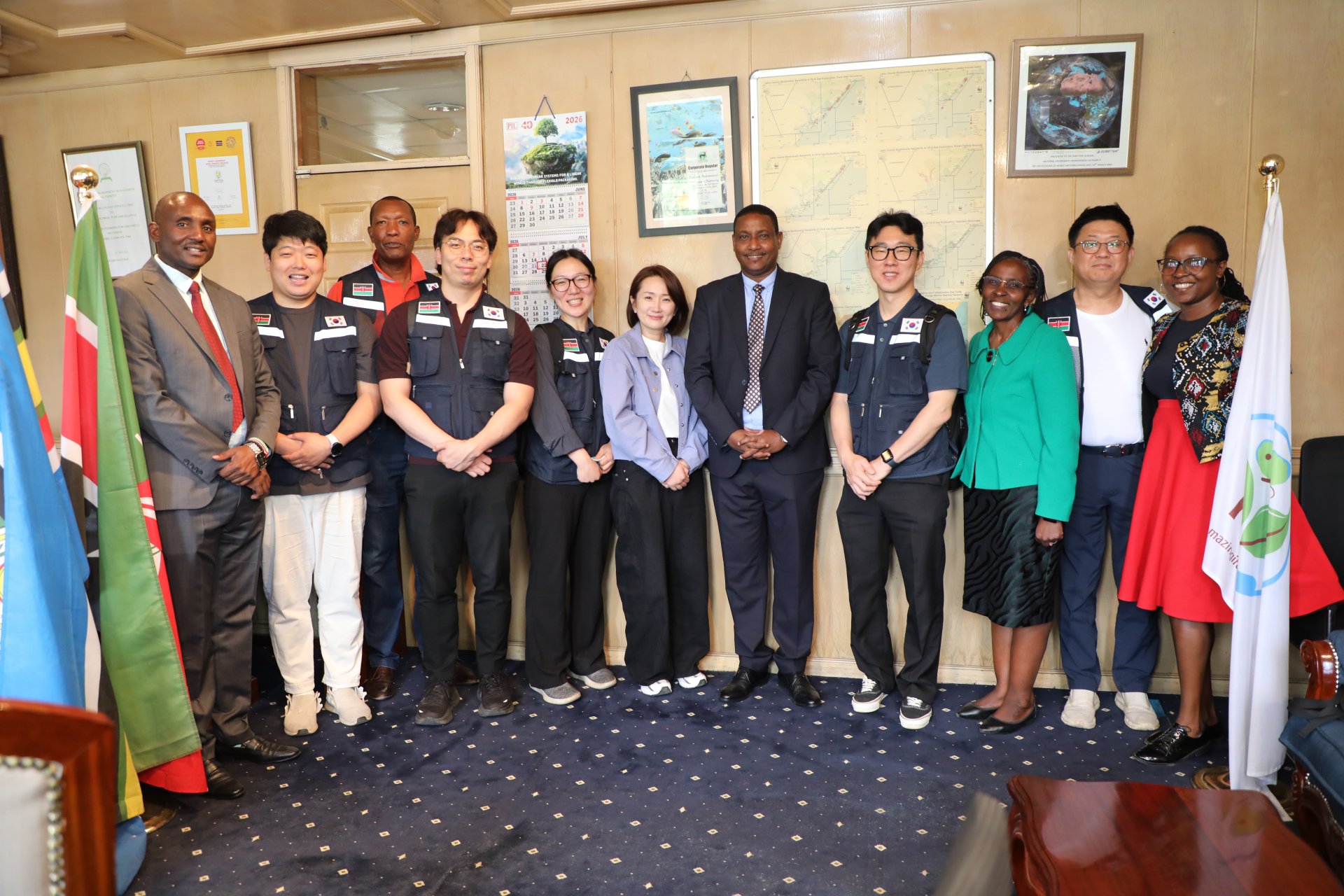
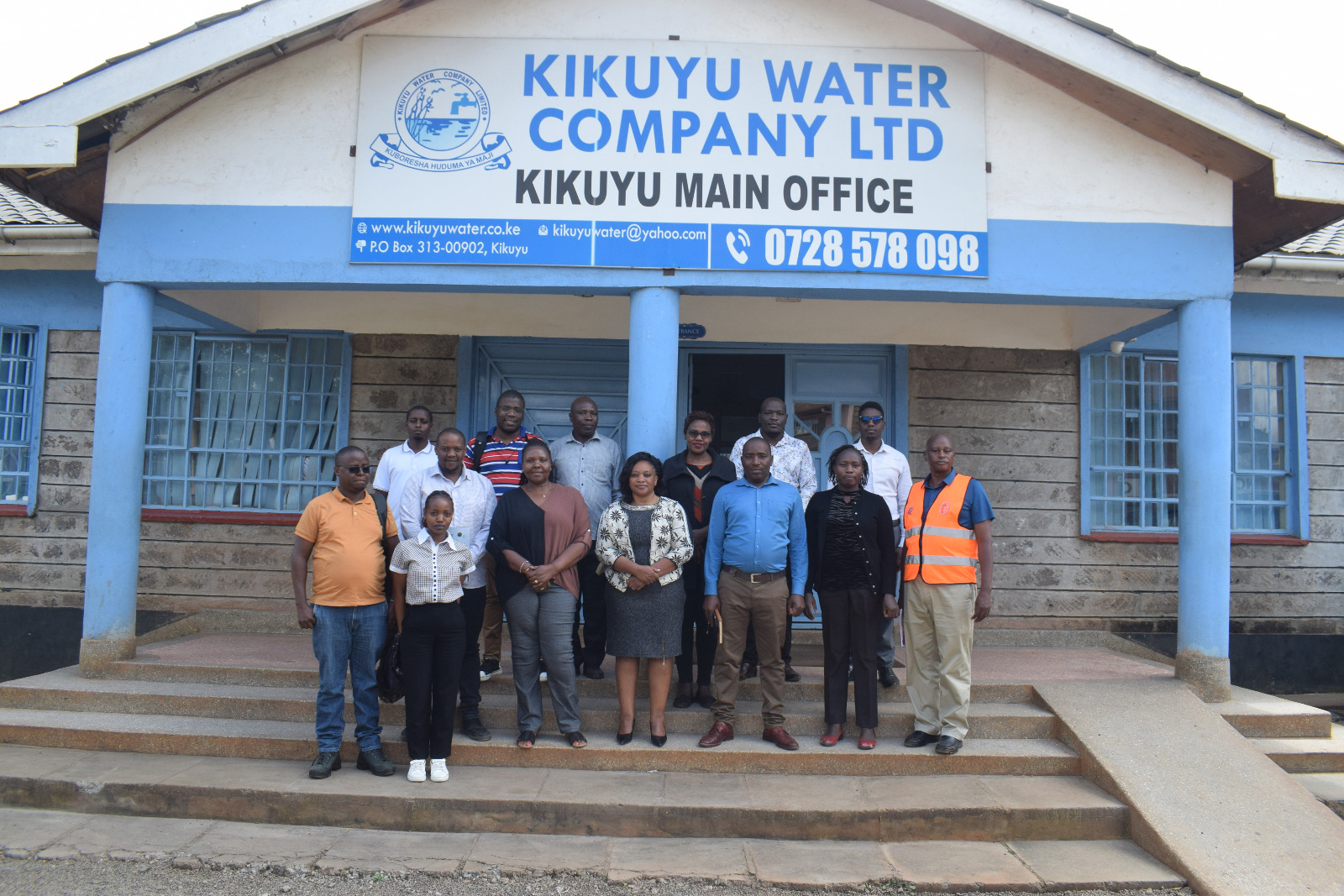
WHAT IS NIE
National Implementing Entity(NIE) is National legal entities/organisations nominated by a Party / Government and accredited by the Adaptation Fund Board to vet eligible projects for funding from the adaptation fund. For an institution to become NIE it must demonstrate adequate competence in technical capabilities, maintenance of accounts, provisions for external and internal audit, procurement, project management and creating and maintaining an ethical and corruption‐free environment. The NIEs- bear full responsibility for the overall management of the project and programmes in terms of financial, monitoring and reporting responsibilities
ADAPTATION FUND
The Adaptation Fund is a self-standing fund established under the Kyoto Protocol of the UN Framework Convention on Climate Change. The Fund is designed to finance concrete climate change adaptation projects and programs based on the needs, views and priorities of developing countries. A concrete adaptation project -a set of activities aimed at producing visible and tangible results on the ground by reducing vulnerability to CC and increasing the adaptive capacity of human and natural systems.
National Environment Management Authority (NEMA) is the National Implementing Entity (NIE) for Adaptation Fund in Kenya. NEMA was nominated by the Ministry of Environment, Water and Natural Resources to be the NIE under the Adaptation Fund (AF). In March 2012, NEMA obtained its accreditation by the Adaptation Fund Board of UNFCCC. This accreditation gave NEMA the mandate to offer vetting, approval and supervision of projects financed by the Adaptation Fund. The NIE bears full responsibility for the overall management of programmes and project in terms of financial, monitoring and reporting to the Adaptation Fund.
The approval of this Programme was a huge success to NEMA and indeed to the entire country as the funds will go towards building resilience among vulnerable communities who are susceptible to the adverse impacts of climate change. As the NIE for Kenya, NEMA will disburse the monies from the fund to its three main Executing Entities (that is, Coast Development Authority, Kenya Forestry Research Institute and Tana and Athi River Development) who are the programme implementers.
Related Links
- Kenya Adaptation fund programme
- Programe Components
- Governance Structure
- Programme Areas (Counties)
- Executing Entities
- Programe Sites (MAP)
- Documents
- Green Climate Fund

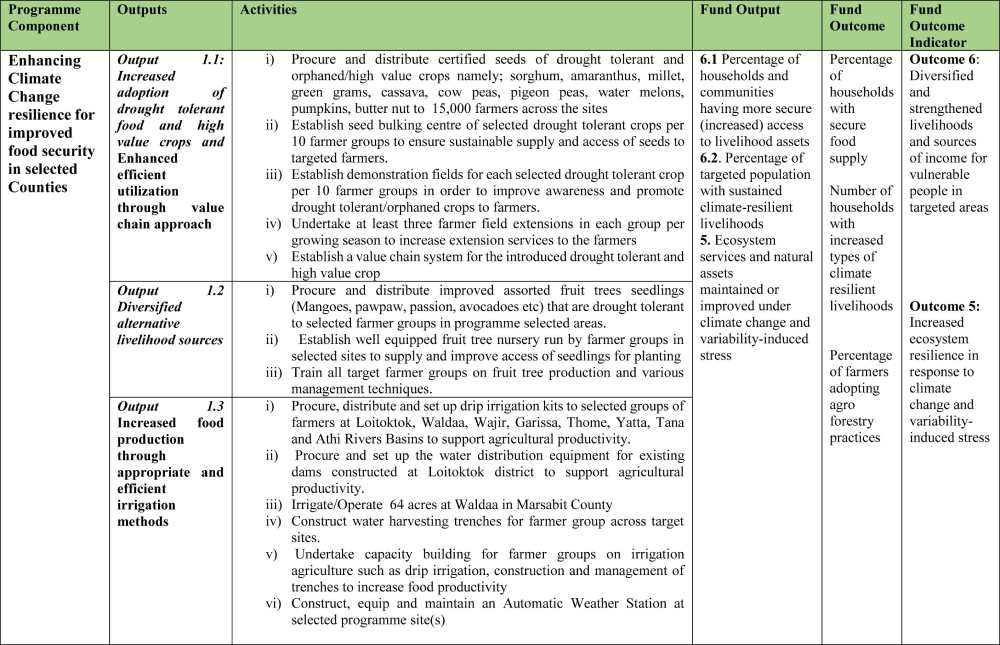
Component 1 – Enhancing Climate resilient agricultural, agro-forestry, pastoral and agro-pastoral production systems to improve food security in selected Counties in Kenya.
The communities in rural areas mainly depend on rain fed agriculture and pastoralism for food and sustainable livelihood. Effects of climate change greatly impacts on these natural resources leading to food shortages and death of livestock. The programme therefore promotes suitable farming practices and methods to improve both livestock and crop based production within households. The programme has six 6 outputs
Key Result Areas
3000 farmers groups working with drip irrigation
15,000 farmers achieving 25% average increase in food production per Ha.
15,000 House Holds with a 25% increase in food consumption.
30% reduction in negative coping strategies
48,000 drought tolerant fruit trees seedlings planted by farmers
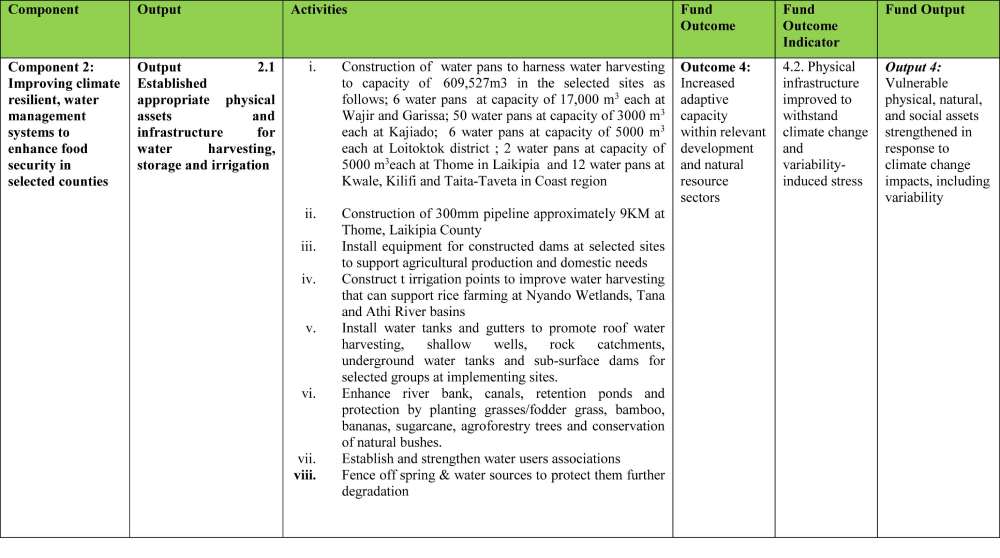
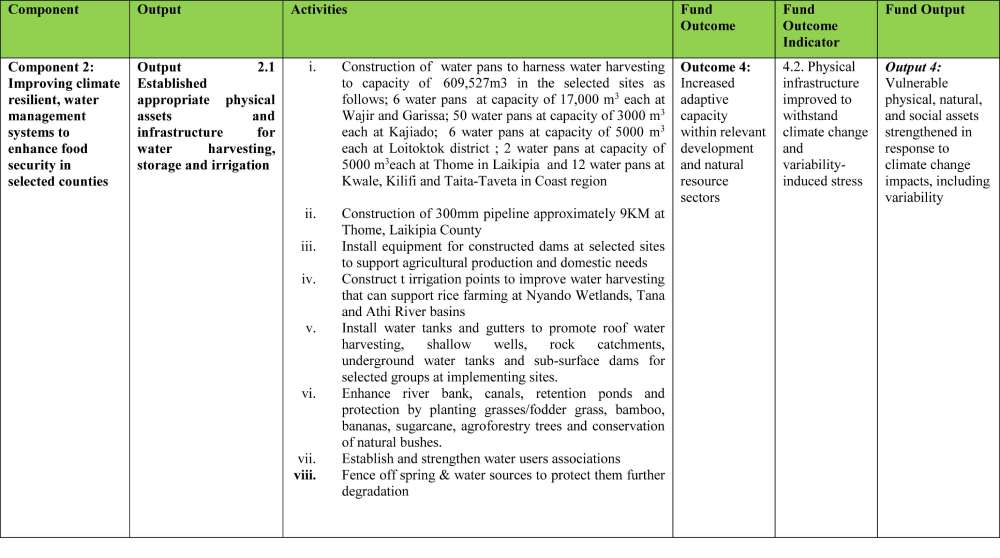
Component 2: Improving climate resilient water management systems to enhance food security in selected Counties in Kenya
The effects of climate change have led to prolonged drought , erratic rainfall drying of wetlands, seasonal rivers and water springs. This has affected several sectors such as agriculture , livestock and industries. The programme through this component focuses on adaptation activities that will improve water resources to support other sector economies.
Key result areas
- Construction of 2 irrigation schemes (Laikipia and Masinga)
- 609,527 M3 capacity water harvesting structures constructed
- Construction of 300mm pipeline approximately 9km.
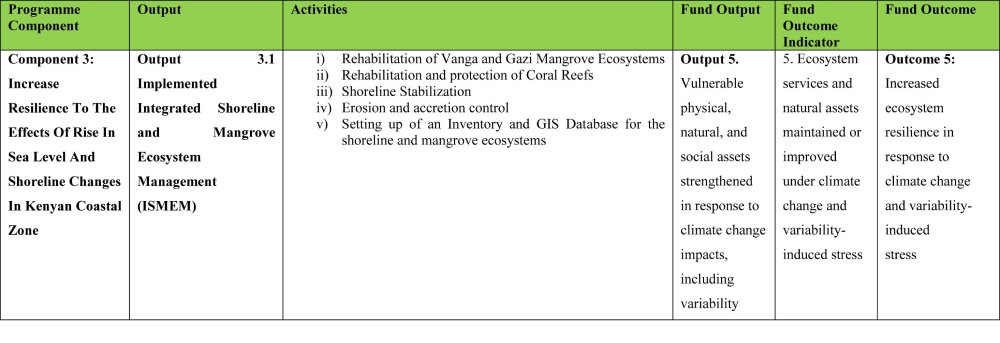
Component 3: Increasing resilience to the effects of rise in sea level and shoreline changes through Integrated Shoreline and Mangrove Ecosystem Management at Vanga and Gazi in the Coastal region of Kenya
The coastal and marine ecosystems are rich with natural resources which support local and national economies which include fisheries coastal forests mangrove forests seagrass beds , coral reefs , river basins deltas and estuaries , beaches and sand dunes as well as cultural and natural heritage. The climate change effects has impacted on the coastal areas leading to rise in sea levels , coral reef bleaching and destruction of mangrove due to flooding and drought. The programme is communing up with a sea wall to protect human settlements . This will be combined with magroove restoration to protect the shoreline. To address the challenge of coral bleaching the programme is rehabilitating the coral reefs.
Key result areas
- Stabilize at least 4.81 km of the Vanga Shoreline
- Secure at least 3,579 households from the effects of sea level rise and shoreline changes in Vanga
- Rehabilitate at least 2,815 Ha of the Vanga and Gazi Mangrove Ecosystems
Component 4 :Disaster risk reduction among targeted vulnerable communities for climate related risks in Kenya
The level of preparedness for climate change related risks such as flooding , erosions loss of livestock, prolonged drought and crop failures is very low and weak in the country . There has been frequent occurrences of these scenarios due to effects of climate change leading to loss of property ,lives and destruction of infrastructures among others. The programme seeks to address the challenges through establishment of early warning systems and construction of automatic weather stations , establish community based friendly information dissemination sytems , establish evacuation centres and construction of flood control structures.
Key Result Areas
- Construction of Dykes in four identified sites along River Nyando
- Construction of flood control structures in the Yala basin (10 Km stretch)
- Construction of 4 evacuation Centers
- Developed system of sending disaster alerts
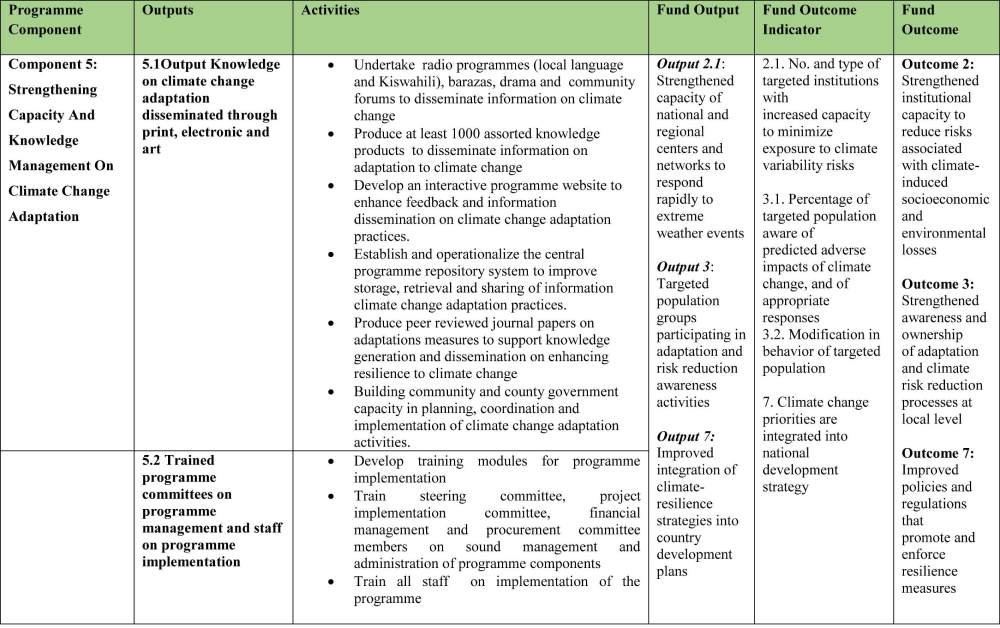
Component 5 : Strengthening institutional capacity, knowledge management, awareness raising and promotion of adaptation mechanisms to improve resilience on climate change to selected vulnerable communities in Kenya
The component has been designed as a knowledge management humb to share information and best practices in climate change adaptation.
Key result Areas
One empirical research study
Information Education Communication (IEC) materials developed and distributed
12 Radio talk shows on Disaster Risk Reduction
Web portal for interactions
One database for documentation of programmer implementation processes
One Documentary developed for the programmer
1 Policy makers, ministerial training
10 farmer exchange field tours
One conference to profile disseminate best practices
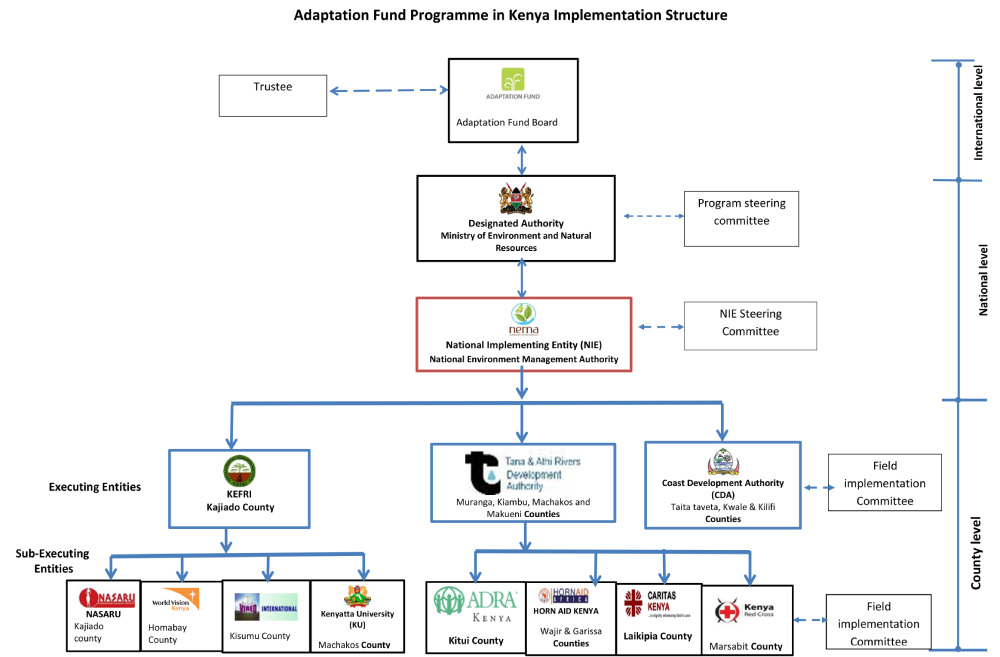
The programme covers Fourteen (14) counties. Each of the 14 counties has one or more programme site which are implemented by the ten( 10) Executing Entities namely Tana and Athi Rivers Development Authority (TARDA), Horn Aid Kenya, Coastal Development Authority(CDA), Kenya Forestry Research Institute (KEFRI), Victoria Research and Development (VIRED) International , Adventist Development and Relief Agency (ADRA) Kenya, Caritas Nyeri , Nasaru Community Based Organization ,Kenya Red Cross Society and Kenyatta University.
Embu County
The programmes site is located at Machanga Siakago subcounty. The Adaptation programme is constructing an Earth Dam at machanga to address the water shortage in the area . This progremme is managed by Tana and Athi Rivers Development Authority.
Garissa County
The projects seeks to create resilience in food and water by construction of dams and creating green zones in farmlands. The project is being executed by Horn AID Kenya. The programme site in Garissa County is being executed by Horn AID Kenya. The sites are located in fafi sub-county which include sites at Daad Bulle and Sankuri in Balambala constituency. The area has frequent droughts during the dry seasons and at times experiences flooding during the rainy seasons.
Kajiado County
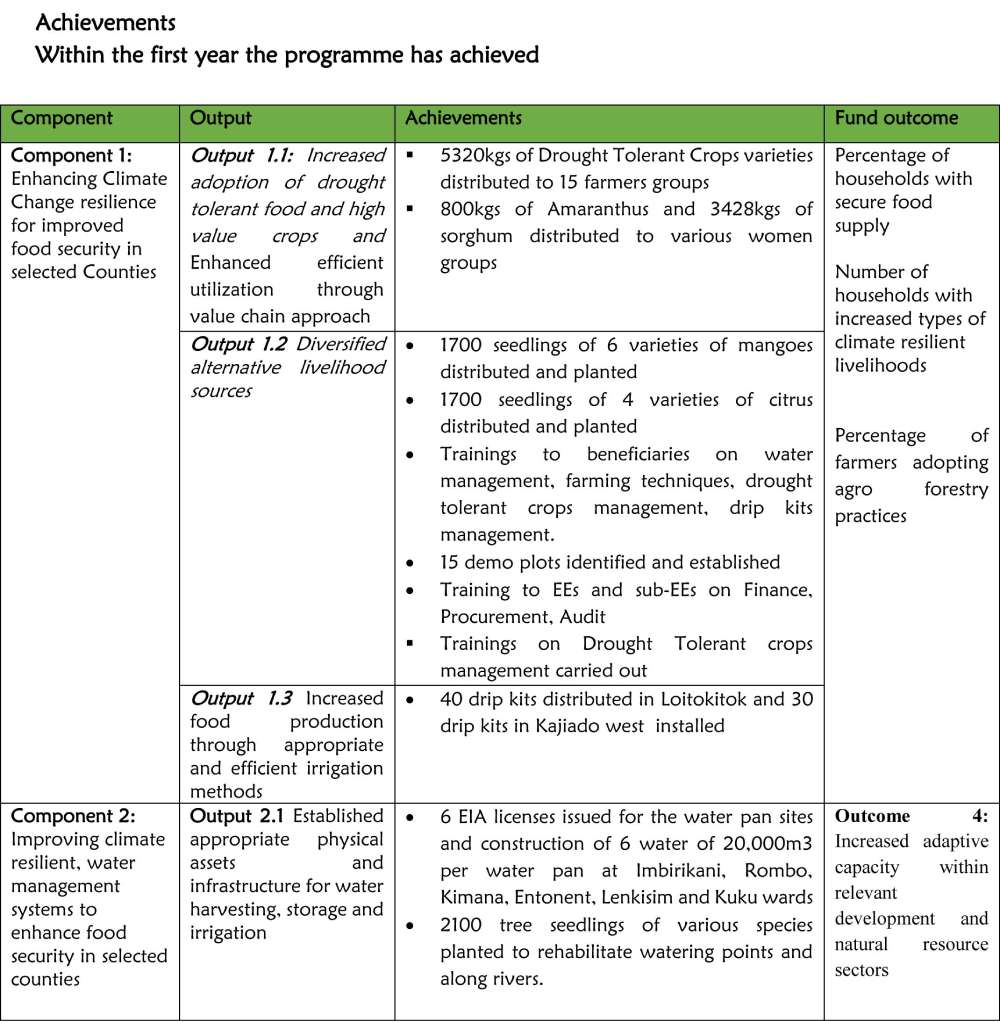
There are two Kenya Climate Change Adaptation Fund Programme sites in Kajiado County these include Loitokitok sub-county site, managed by Kenya Forestry Research Institute (KEFRI), and Kajiado west sub-county managed by Nasaru community Based organization. The project sites in Kajiado addresses programme Component 1: Enhancing Climate Change resilience for improved food security and Component 2: Establishing Climate Change resilient water management systems to enhance food security.
During the implementation of the Programme, Kenya Forestry Research Institute (KEFRI) in collaboration with various stakeholders will promote climate resilient agricultural, agro-forestry, pastoral and agro-pastoral production systems to improve food security in the area. The institute together with collaborating partners will also spearhead water conservation and harvesting technologies, promotion of efficient cooking technologies and charcoal production kilns to reduce risks associated with climate change and improve the adaptive capacity of selected vulnerable communities in the area.
The programme through KEFRI is distributing grafted Mangoes and citrus fruit trees and drought tolerant seeds, drought resilient grass, fodder and forage, hay making equipment’s, and construction of Food storage, bulking center for storing hay and demonstration on Value addition for selected fruits. Further the programme seeks to rehabilitate livestock watering points and along rivers and construction of water pans at various location.
KEFRI through the adaptation fund programme is also creating awareness on climate change, impacts and adaptation through, publications, meetings and Radio programme. On the other hand programme through NASARU Community Based Organization is addressing food security through distribution and planting of drought tolerant seeds of orphaned crops and introducing micro- irrigation kits for kitchen gardens. The programme is also distributing of drought tolerant fodder and fodder making equipment’s as well as training farmers on hay making. The programme seeks to address strengthen the community livelihood through distribution of Aloe Vera seedlings to households and training farmers in Aloe processing.
Through NASARU the programme is constructing water pans and water troughs.
Kilifi County
The project site is located in Midoina in Mwahera location of Ganze sub county, Kilifi county and also in four( 4) schools within Kilifi county namely Matolani Primary, Kirumbi Girls secondary, Bandari Secondary and Karimboni primary. The county has challenges with the water scarcity, flooding and coastal area biodiversity destruction. The project is being executed by Coastal Development Authority and seeks to increasing resilience to the effects of rise in sea level and shoreline changes through Integrated Shoreline and Mangrove Ecosystem Management and improve climate resilient water management systems to enhance food security in the Coastal region of Kenya.
Kitui County
The project is being implemented by Faith based organization Adventist Development and Relief Agency ADRA. The project sites are in lower Yatta Sub-county, Kitui County. To the eastern side of the county, the main relief feature is the Yatta plateau, which stretches from the north to the south of the county and lies between rivers Athi and Tiva. The plateau is characterized with plain wide shallow spaced valleys.
The climatic condition varies across the county in terms of rainfall and temperature. The rainfall pattern is bi-modal with long rains falling in the months of March to May. These are usually very erratic and unreliable rainfall. The short rains which form the second rainy season fall between October and December and is a bit reliable. The county experiences high temperatures throughout the year, which ranges from 140c to 340c. The projects seeks to address enhance food security and water
Kisumu County
Kisumu CountyKisumu CountyThe site lies along Nyando catchment in the eastern sub-catchments of the Lake Victoria.It covers an area of 3,600 km2. There have also been land use changes as a result of intensive deforestation in the upper catchment of Nyando River basin leading to flooding during the rainy seasons. The project is being implemented by Victoria Research and Development (VIRED) International a non-governmental organization.
Through the adaptation fund programme the organization is addressing component 4 Disaster Risk Reduction and Increasing Preparedness among Vulnerable Communities by Construction of 4 water pans and dykes and Un-blocking of water channels.
The programme also seeks to rehabilitate river banks by planting bamboo seedling along river Nyando. Adaptation fund also seeks to develop early warning systems, capacity building and awareness of communities on disaster preparedness and construction of evacuation centers in Nyando area. The organization is also involved in carrying out research on Climate Change Adaptation.Flood control structures, evacuation centres will be the primary initiatives in this area.
Kwale County
The programme sites in Kwale County are located in Vanga and Gazi areas. The project is being executed by Coast Development Authority and mainly focuses on rehabilitation of the coastal areas kenya. The region’s climate is tropical humid characterized by dry spells and unpredictable rainfall.
Supply of portable water has not kept pace with population growth and urban development in the coastal region. Consequently, majority of the population has resorted in abstraction of groundwater by sinking boreholes and shallow wells. Some tourism facilities have also lead in increased use of the available brackish groundwater for toilet needs. Over-extraction of groundwater and destruction of water catchments has exacerbated the water supply problem and threatened the ecosystem hydrological functions thus the need for strategies to address these issues.
Laikipia County
The programme site is located in Thome, Matanya sub-location, Laikipia Central Sub County. The rainfall in Thome area lies between 700-800mm on average per year with some areas receiving less than 600mm.
The low amounts of rainfall with varying patterns have led to continued decrease in river discharge, causing conflicts between upstream and downstream users. For instance, the Naro Moru River was perennial and a reliable source of water up to the early 1990s.
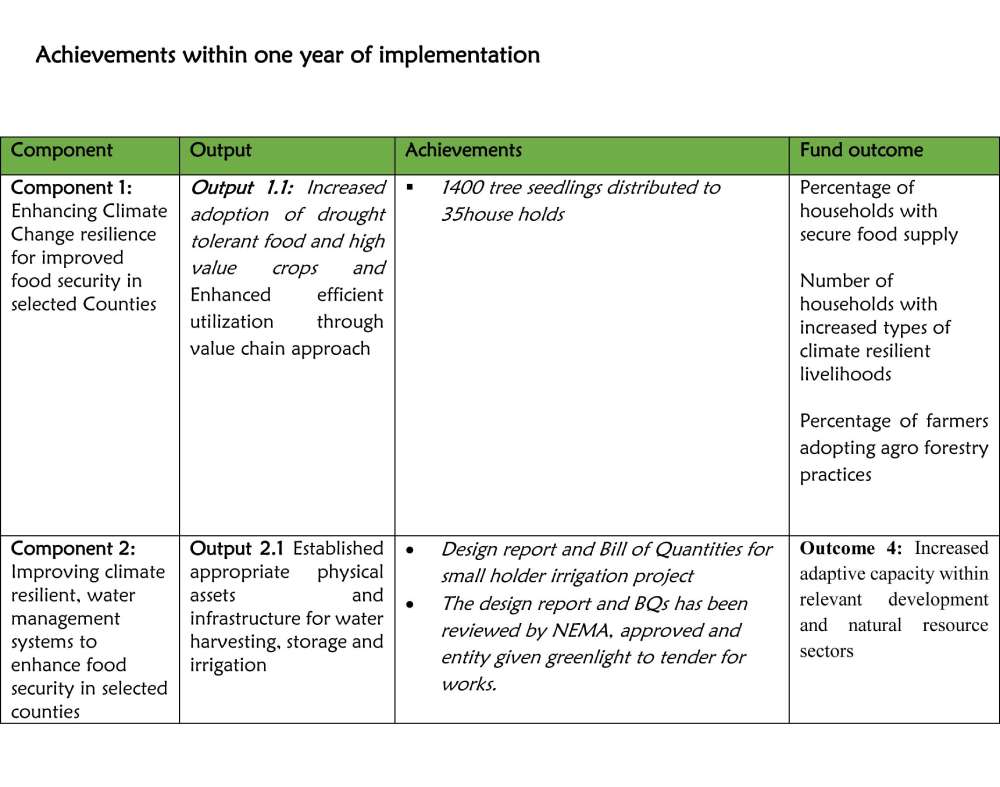
However, in the past decade the river has repeatedly run dry over extended periods of time.To adapt to climate change the adaptation fund programmes seeks to construct of water harvesting and water supply infrastructures, supply micro drip Kits with a 2000litres, water storage tank, and promotion of drought resistant crops and conservation of environment through agro forestry.
Re-engineering and reconstruction of the Thome river intake channel, construction of one 25,000m3 water reservoir, 300mm wide water distribution pipes covering 9.348km, water pans with capacity of 5,000m3 and storage masonry tanks and water distribution pipelines and distribution of 40 tree seedlings per household, and other drought tolerant seeds and community level capacity building.
The project is being executed by Caritas- Nyeri.
Machakos County
There are two project sites in Machakos County. These projects are being executed by Tana and Athi Rivers Development Authority (TARDA) and Kenyatta University
Makueni County
Makueni county has 64.3% households that use unimproved water sources, 35.7 % access improved water sources and only 17.7% have access to piped water. Athi River and Kibwezi River are the only permanent rivers serving the entire county. The majority of the populations depend on surface and subsurface dams for water, which often do not hold sufficient water due to high evaporation rates during the dry seasons.
The vast area of the county and the population is therefore inadequately supplied with water and the average distance from a water point is at 8kms. This has therefore led to severe water shortages for domestic, livestock, crop and industrial use. Being an ASAL region the County hardly receives sufficient rainfall. The groundwater resources are low and saline because of the basement rock systems. This has greatly affected agricultural and livestock production as most farmers are forced to depend on rain fed agricultural production. Tana and Athi Rivers Development Authority is implementing the project in Makueni County at at Wanduli Earth Dam, Kibwezi West. The adaptation fund projects seeks to address the resilience to water shortages.
Marsabit County
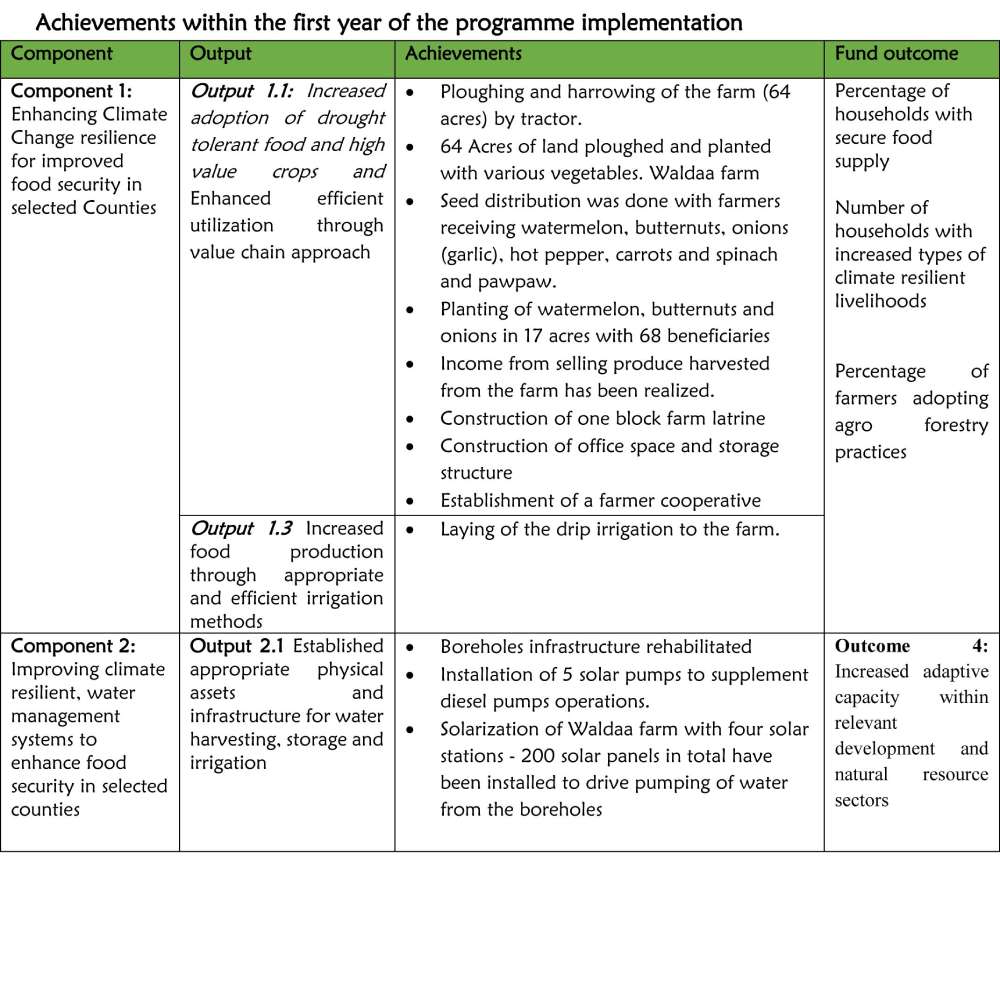
The adaptation fund site in Marsabit County is located at Waldaa, Sololo sub-county. The area experiences prolonged drought throughout the year. In this area Kenya Red Cross Society (KRCS) has embarked on early recovery initiatives aimed at opening up land under irrigation in Waldaa as a disaster risk reduction strategy and enhancing food security.
Kenya Red Cross with local people will construct water pans to supply water for domestic and irrigation to improve resilience and adaptive capacity to climate change of the rural poor. Water harvested during the rainy seasons will be used in irrigation. Modern farming methods which are climate SMART (pressure compensated drip irrigation) will be adopted and solar energy will be used to power the pumping equipment’s , which will reduce fuel use and minimize any harmful emissions to the environment.
The adaptation fund site in Marsabit County is located at Waldaa, Sololo sub-county. The area experiences prolonged drought throughout the year. In this area Kenya Red Cross Society (KRCS) has embarked on early recovery initiatives aimed at opening up land under irrigation in Waldaa as a disaster risk reduction strategy and enhancing food security.
Kenya Red Cross with local people will construct water pans to supply water for domestic and irrigation to improve resilience and adaptive capacity to climate change of the rural poor. Water harvested during the rainy seasons will be used in irrigation. Modern farming methods which are climate SMART (pressure compensated drip irrigation) will be adopted and solar energy will be used to power the pumping equipment’s , which will reduce fuel use and minimize any harmful emissions to the environment.
Murang’a County
The project sites in Muranga are located at Maragua(Fruit processor)in and Ajibika weir in kigumo sub county. The two projects are being implemented by Tana and Athi Rivers Development Authority (TARDA)
Taita Taveta County
The Kenya Adaptation fund project sites in Taita Taveta is located within 4 schools namely;
- Orkungu Primary,
- Mwakishimba Primary,
- Mgeno Primary and
- Kajire Girls Secondary.
Coastal development Authority as an executing Entity, seeks to address the challenges of Over-extraction of groundwater and destruction of water catchments by encouraging water harvesting technologies.
Wajir County
The Kenya Adaptation fund project sites in Taita Taveta is located within 4 schools namely;
- Orkungu Primary,
- Mwakishimba Primary,
- Mgeno Primary and
- Kajire Girls Secondary.
Coastal development Authority as an executing Entity, seeks to address the challenges of Over-extraction of groundwater and destruction of water catchments by encouraging water harvesting technologies.